
Architecture and Power | Gustavo Acosta
The Start of The Season | Gustavo Acosta
At first glance, Gustavo Acosta paints cities.
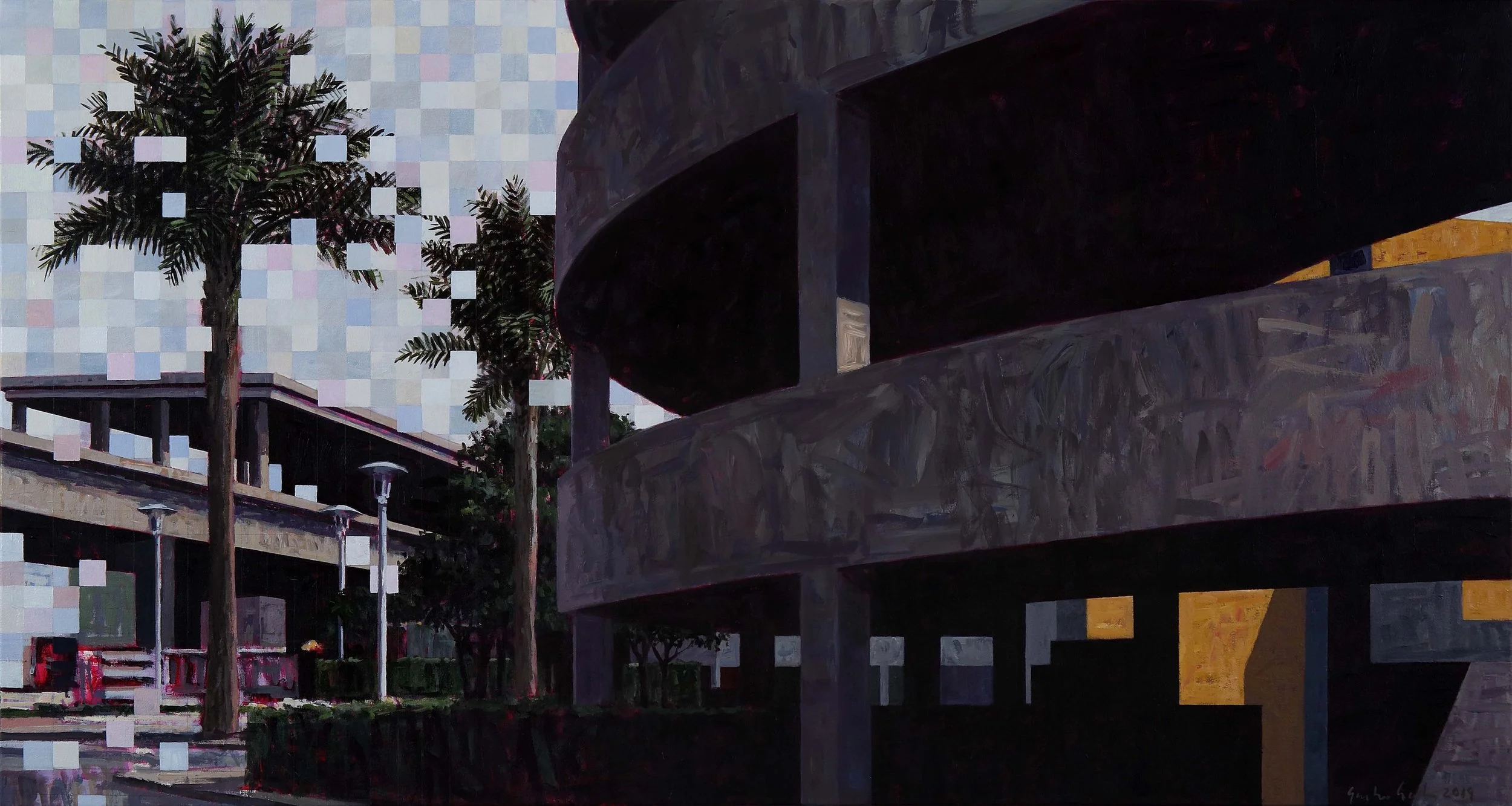
Buildings rise out of darkness. Streets recede toward uncertain destinations. Parking structures, towers, monuments and fragments of urban infrastructure occupy spaces in which people are conspicuously scarce. Light appears through windows or breaks across concrete. Sometimes the city is immediately recognizable; elsewhere it seems assembled from observation, recollection and invention.
But architecture has never been merely Acosta's subject.
For more than four decades, it has been his language.
Born in Havana in 1958, Acosta studied at the San Alejandro Academy of Fine Arts and later at Havana's Instituto Superior de Arte. He emerged during the extraordinary period of Cuban art in the 1980s, when a generation of artists began testing the boundaries of what could be said, represented and questioned within the cultural apparatus of the Cuban state. Acosta received the National Prize for Drawing at the first Havana Biennial in 1984 and became part of a generation that would profoundly influence the course of contemporary Cuban art.
Acosta found his vocabulary in the built environment.
Architecture is, after all, rarely neutral. Governments build monuments. Institutions build imposing headquarters. Empires announce themselves in stone. Financial power reshapes skylines. Political systems leave behind plazas, ministries, housing projects, walls, ruins and infrastructure.
A building can tell us who possessed power, what they wanted us to believe about that power and, eventually, what became of it.
Acosta understood this early.
Architecture as Code
During the 1980s in Cuba, Acosta began incorporating references to Roman architecture into his paintings. On the surface, the imagery could be read as historical. Beneath it was something considerably more contemporary.
Writing about this period, curator Irina Leyva-Pérez has described Acosta's use of Roman architecture as a means of drawing a parallel between imperial authority and the Cuban political system. Acosta himself later explained that the historical symbolism served two purposes: it allowed him to speak about power while providing a degree of protection from censorship, and it offered viewers willing to look more closely another reading entirely.
That distinction is essential to understanding his work.
Acosta was not painting buildings because buildings interested him as architectural portraiture. He was examining the systems that buildings represent.
The architecture became a code.
It allowed him to address authority without illustrating authority literally. There was no need to paint a political leader when the structures created by political power could speak instead.
It is one reason his paintings can initially appear quiet and become increasingly unsettling the longer one looks.
The City After the People
There is another persistent characteristic of Acosta's cities: they are often strangely empty.
The absence matters.
In conventional city painting, architecture provides a setting for human activity. In Acosta's work, the relationship is frequently reversed. Human beings have constructed these enormous systems, yet the structures remain after the people have disappeared.
What is left is evidence.
A city becomes a record of ambition, ideology, prosperity, neglect, control, collapse and reinvention. Buildings survive governments. They outlast businesses. They remain after populations migrate and political convictions change.
Acosta has described his broader project as an investigation of the human condition through humanity's creative footprint rather than through the individual figure. Architecture becomes testimony.
This is why the absence of people does not make these paintings unpopulated.
We are everywhere in them.
Havana, Exile and the Changing City
Acosta left Cuba in the early 1990s, spending time in Mexico and Spain before settling in Miami in 1994. His departure changed his relationship with the city but did not sever it. Havana continued to appear in the work, now complicated by physical distance and the strange experience of remembering a place that continues to exist without you.
Other cities entered the paintings as well.
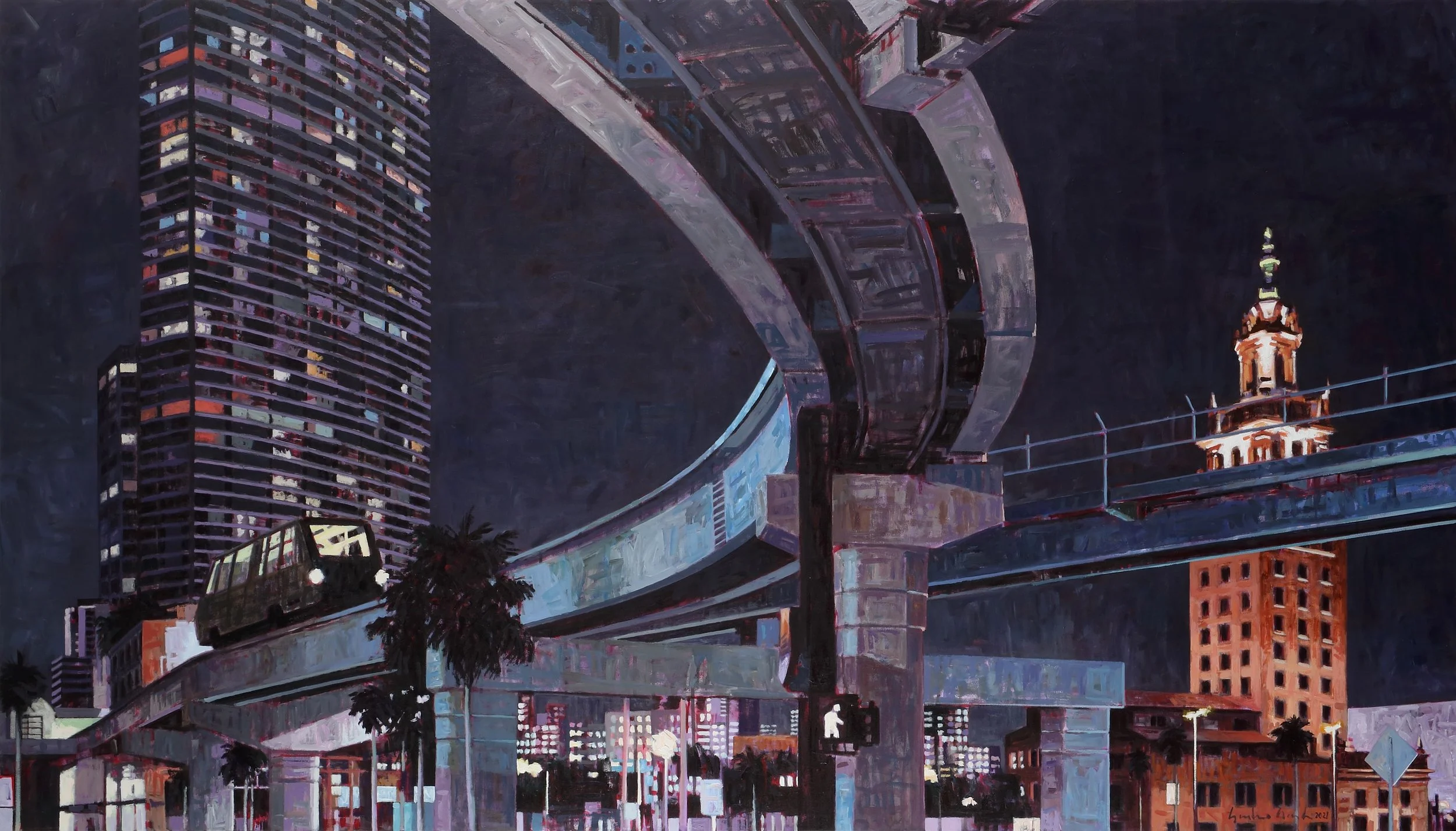
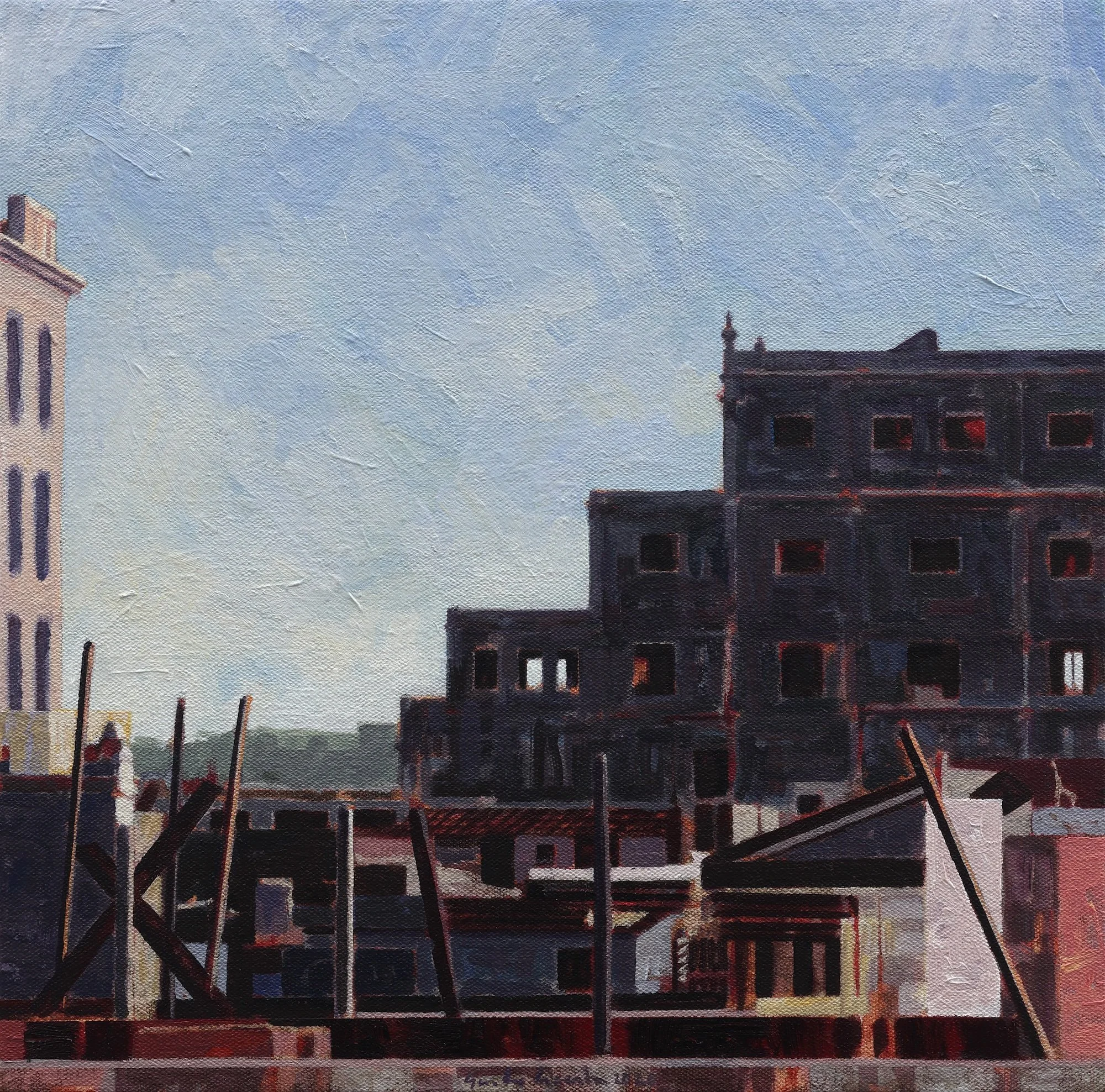
Miami is particularly significant because it offers an almost inverse architectural condition to Havana. One city has been marked by deterioration, arrested development and the physical residue of a political system; the other is continually being demolished, rebuilt, expanded and transformed by capital.
Unpredictable | Gustavo Acosta
Acosta has examined both.
A 2016 exhibition, Paper Trail, explicitly placed images of rapidly changing Miami against deteriorating buildings in Havana. The contrast was not simply Cuba versus America. It was about different manifestations of power and the different marks they leave on cities.
That evolution is important because it prevents an overly simple political reading of his work.
Cuba gave Acosta an acute understanding of the relationship between architecture and centralized political authority. Leaving Cuba did not cause the subject to disappear. It expanded it.
Power exists elsewhere too.
It may be governmental, institutional, economic or cultural. Its architecture changes accordingly.
Painting What Power Leaves Behind
This is where Acosta's work moves beyond its Cuban context.
A viewer does not need to know Havana to understand the sensation of standing before a structure designed to overwhelm the individual. Nor does one need to have lived under the Cuban government to recognize the authority projected by a courthouse, corporate tower, government ministry, financial district or abandoned monument.
Buildings communicate.
Scale communicates.
Light communicates.
So does decay.
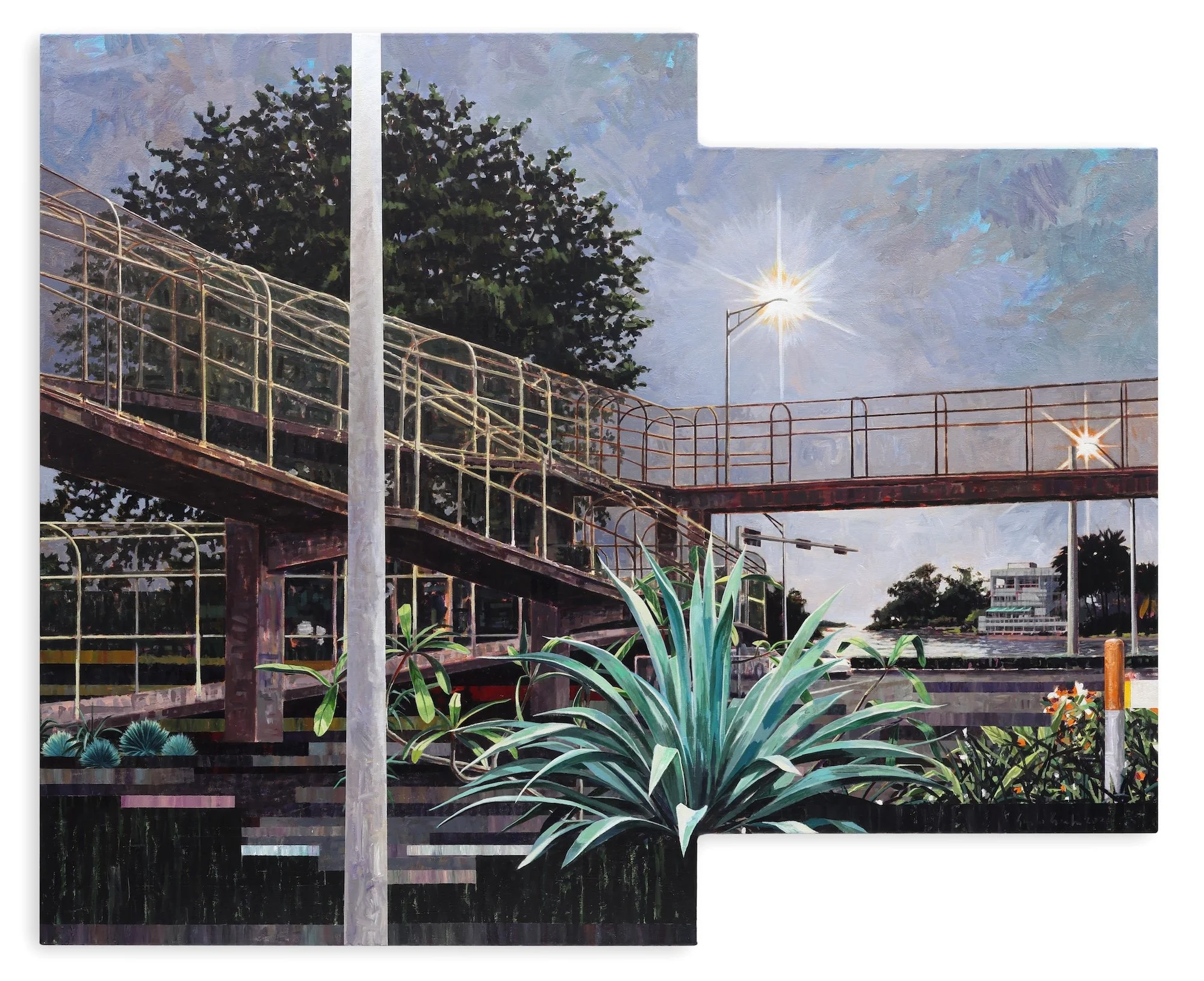
Acosta's paintings repeatedly move between those states. Structures appear monumental and vulnerable at once. Light can make a building seductive while darkness makes the same structure impenetrable. Nature sometimes encroaches upon what human beings have built. Elsewhere, architectural order seems almost absolute.
The paintings resist telling us exactly what has happened.
Instead, they ask us to examine what remains.
A Painter's Painter
The conceptual strength of Acosta's work can obscure another reason for its importance: he is an exceptional painter.
The ideas would carry considerably less force without the technical command behind them.
His compositions depend on rigorous perspective and architectural structure, but they are not exercises in precision. Surfaces dissolve. Edges disappear. Passages approach abstraction before returning to recognizable form. Scraping, layering, shadow and illumination disrupt the certainty of the structures themselves.
Critics have noted this movement between figuration and abstraction throughout his career. The city provides order; the paint continually threatens to undo it.
That tension is fundamental.
Acosta gives us architecture, one of civilization's great assertions of permanence, through painting, a medium capable of making solidity dissolve into pigment.
The contradiction is beautiful.
It is also entirely appropriate.
Intimate Portrait VII | Gustavo Acosta
The Historical Record
Acosta's career now spans more than four decades. His work has been exhibited internationally and is represented in museum and institutional collections including the National Museum of Fine Arts in Havana, the Wifredo Lam Center, the Museum of Contemporary Art in Miami and the Lowe Art Museum, among others. A major retrospective traveled through Caixa Cultural in Rio de Janeiro and São Paulo.
His place within the historical record extends beyond the paintings themselves.
The Smithsonian Institution's Archives of American Art holds the Gustavo Acosta papers, circa 1958–2017, a collection containing artist statements, interviews, correspondence, documentation of his education and artistic production in Cuba, exhibition records, photographs, drawings, sketchbooks and other primary material from his career. Acosta donated the archive to the Smithsonian in 2018.
He is also included in the Smithsonian's collection of interviews with Cuban American artists created by Jorge J. E. Gracia and Lynette Bosch, a project examining immigration, diaspora and the ways Cuban and Cuban American artists negotiated cultural identity.
These archives matter because art history is constructed not only through objects, but through the preservation of the ideas, documents and circumstances surrounding their creation.
Acosta's work belongs to that history.
Architecture and Power
There is a temptation when discussing paintings of cities to fall back on familiar language about place and memory.
Acosta's work demands something more precise.
He paints the things civilizations construct when they believe they will endure.
Governments build. Institutions build. Money builds. Ideologies build. Human beings organize enormous resources to make their ambitions physical.
And then time begins its work.
Political systems change. Economies collapse or expand. Buildings are abandoned, repurposed or demolished. Cities reinvent themselves. The structures that once represented certainty become evidence of something that has already passed.
Acosta has spent much of his career looking at that evidence.
The result is not simply an archive of Havana, Miami or any other city he has painted. It is an examination of the complicated relationship between people and the systems they create, expressed through the physical world those systems leave behind.
The buildings remain.
What they mean is never quite as permanent.
I Learned I Have No Choice | Gustavo Acosta