
Who Is Paula Christenson?
Paula Christenson is an Argentine American abstract painter whose work emerges through intuition, mark making, and a process she often describes as solving a visual equation. Working primarily in acrylic, she creates layered compositions that evolve through spontaneity, observation, and refinement rather than predetermined imagery.
Today, Christenson is known for vibrant abstract paintings filled with movement, rhythm, and interconnected forms. Yet her path to abstraction was anything but direct.
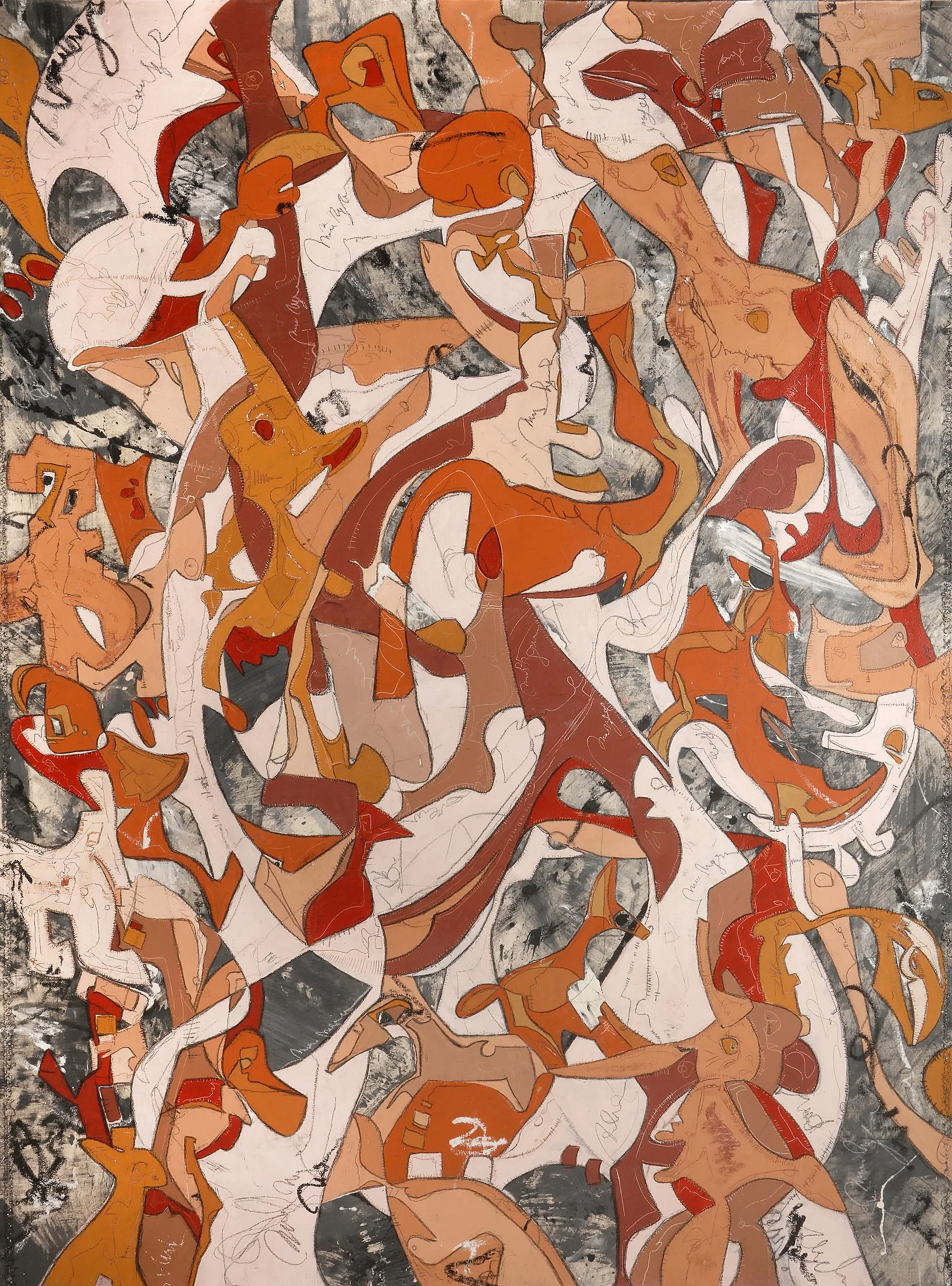
Dreamweb 21 | Paula Christenson
Before embracing abstraction, she painted faces.
Like many artists searching for their own visual language, Christenson spent years exploring different approaches before discovering the one that felt entirely her own. The breakthrough came late at night in the studio, during long periods of experimentation and uncertainty.
Rather than beginning with an image, she began with a line.
Then another.
And another.
As the lines crossed the canvas, they began forming relationships with one another. Spaces emerged between them. Tensions appeared. Possibilities revealed themselves.
What started as simple mark making became something much more complex.
The lines became a problem she needed to solve.
"The lines became a mathematical equation," she recalls. "I needed to find the answer."
That idea remains central to her practice today.
Unlike artists who begin with a clear subject in mind, Christenson allows her paintings to develop organically. While color is often the only predetermined element, the composition itself emerges through a continuous process of response and discovery. Forms appear unexpectedly. Shapes suggest movement, landscapes, architecture, organisms, or imagined worlds. The painting gradually reveals itself through the act of making.
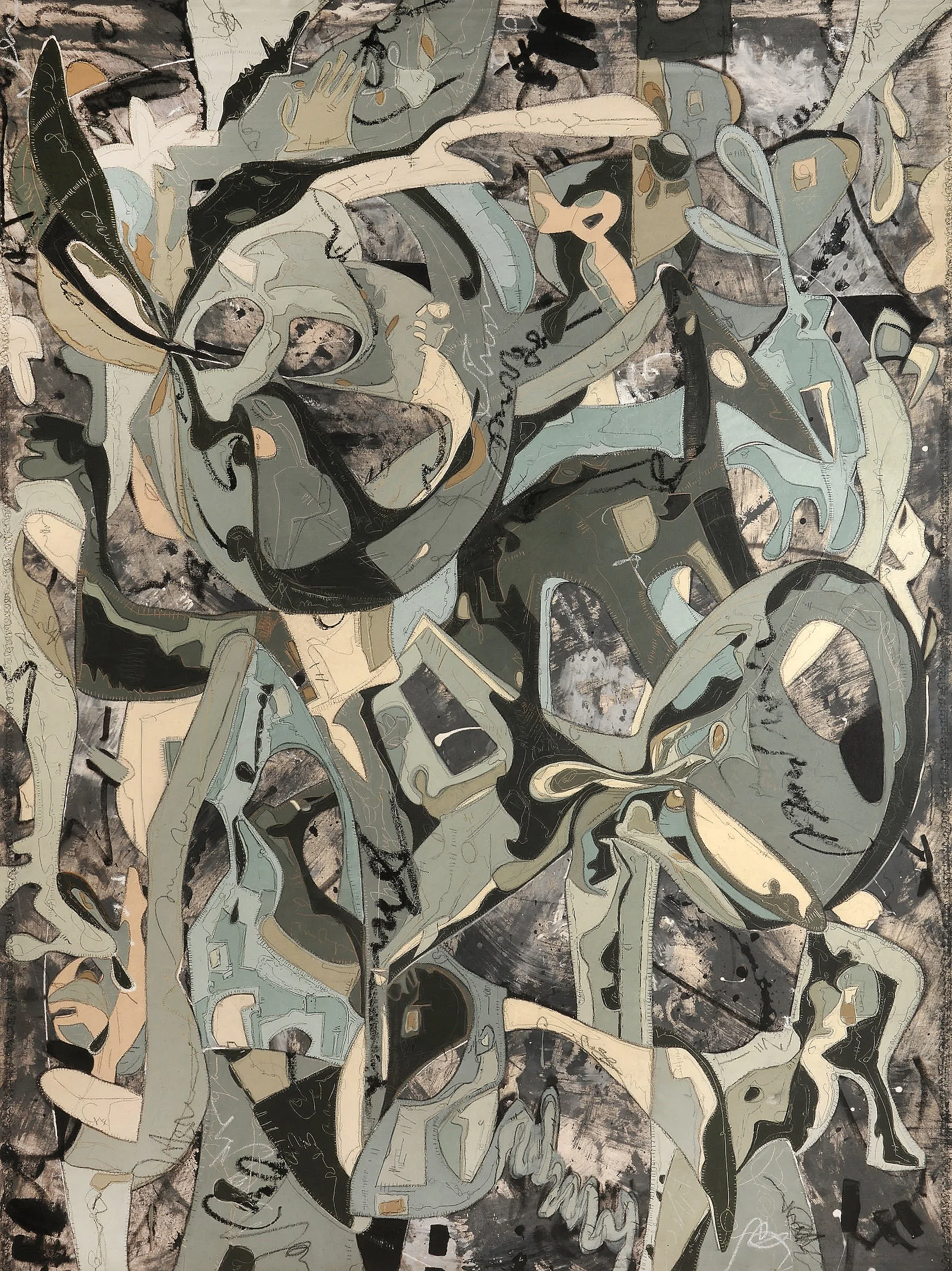
Dreamweb 24 | Paula Christenson
For Christenson, abstraction is not the absence of meaning. It is a language.
The marks themselves carry information. Each line creates new relationships and new questions. Each decision influences the next. What may appear spontaneous is balanced by careful observation and technical refinement as she works toward harmony, rhythm, and visual balance.
This dialogue between intuition and structure gives her paintings their distinctive energy. They feel simultaneously free and deliberate, playful and disciplined.
Nature also plays an important role in Christenson's process. Inspired by artists such as Cy Twombly and drawn to the expressive possibilities of unconventional tools, she frequently creates her own brushes and mark-making instruments from found materials. Leaves, sticks, branches, and other natural elements become extensions of the hand, each producing unique textures and gestures that cannot be replicated by traditional brushes.
For Christenson, every tool carries its own emotional weight.
The physical act of mark making becomes a form of exploration, connecting the artist not only to the painting itself but also to the natural world that inspires it.
Born and educated in Argentina, Christenson later moved to the United States, where she continued developing her artistic practice while raising a family and building a life in a new country. As a non-native English speaker, she has spoken openly about occasionally feeling limited by language. Painting offers the opposite experience.
On the canvas there are no restrictions.
No vocabulary to search for.
No translation required.
Through painting she finds complete freedom, a place where intuition, memory, emotion, and imagination can move without constraint.
Many viewers find themselves searching for recognizable forms within Christenson's compositions. Faces, landscapes, architectural structures, and organic shapes seem to emerge and dissolve simultaneously. The artist herself often speaks of connecting with the forms and entities that appear during the creative process, allowing them to guide the painting toward its final resolution.
That sense of discovery is what makes her work so engaging.
The viewer becomes part of the same journey.
What begins as a line becomes a shape.
What begins as a shape becomes a relationship.
What begins as a question gradually becomes an answer.
Or perhaps another question entirely.
Ultimately, Paula Christenson's work reminds us that creativity is not always about knowing where we are going. Sometimes it is about paying close attention to what emerges along the way. Through mark making, intuition, and a willingness to follow the unexpected, she transforms the canvas into a space where freedom, curiosity, and possibility coexist.